
Downstream Hazard Monitoring
Risk-based insights for downstream hazard monitoring.
Proactively manage downstream risk across your dam portfolio.
Bringing Clarity to Downstream Risk
One of the greatest challenges for dam owners, operators, and regulators is maintaining clear, up-to-date visibility of what lies within their inundation zones—especially as development accelerates and extreme weather events increase in frequency and intensity.
Critical information about downstream buildings, infrastructure, and exposure is often fragmented across systems, reports, and agencies. Between formal inspection cycles, new homes, roads, and community assets can emerge within flood extents, creating hazard creep that may go undetected.
As climate-driven events intensify, downstream consequence risk is no longer theoretical. You need a scalable, defensible approach that brings clarity to downstream exposure—before an emergency occurs.
Insight-Led Management of Downstream Hazards
Trusted by dam operators and state regulators, Rezatec’s Downstream Hazard monitoring delivers clear, actionable insight into infrastructure exposure within inundation zones—combining advanced geospatial analytics with automated building and address identification.
This scalable solution enables you to detect downstream development, identify hazard creep between review cycles, and prioritize dams requiring closer assessment. By providing rapid access to impacted infrastructure data, it strengthens Emergency Action Planning, improves hazard classification defensibility, and supports risk-informed decision-making across your entire portfolio.
A Single View of Downstream Exposure
Visualize inundation zones, downstream buildings, and associated address data within a single, intuitive geospatial platform. Gain immediate clarity on what assets lie within potential flood extent, without stitching together multiple datasets or systems.
Quickly filter and compare dams by exposure level, hazard rating, or county, and collaborate across teams to prioritize review.


Satellite Intelligence for Downstream Impact Analysis
-
Automated identification of buildings and associated address data within inundation zones
-
Detection of urban growth and development inside flood extents
-
Ongoing screening for downstream exposure changes
-
Consistent, repeatable analysis across entire dam portfolios
This enables earlier identification of downstream consequence changes that may influence hazard classifications, Emergency Action Planning, and resource prioritization—before an emergency occurs.
Risk-Focused Emergency Planning & Compliance
By identifying downstream exposure at scale, teams can prioritise response planning, improve coordination, and reinforce a proactive, risk-informed approach to dam safety management.

Key Advantages of Our Solution
Why Downstream Monitoring Matters
Downstream information is often dispersed across mapping systems, planning documents, and agency records, making consistent review difficult. Without a structured, repeatable way to assess consequence exposure, prioritization becomes reactive rather than strategic.
Rezatec’s Downstream Hazard monitoring provides a clear, consistent framework for understanding downstream consequence risk across your portfolio—helping teams move from fragmented data to informed action.
Risk-Focused Regulatory Support
Proactive Hazard Detection
Cost Efficient Risk Insight
Clearer Data, Stronger Decisions
Brings downstream exposure intelligence into a single, accessible environment—supporting collaboration across dam safety, engineering, and emergency management teams.
Early Visibility into Downstream Change
Scalable for Complex Catchments
Confidence Trusted by Dam Safety Professionals Worldwide
Jeanne Finger, Chief Dam Safety Engineer, City of Spokane
Billy Cothran, Chief Executive Officer, SJWD
Dan Turnbull, Dam Safety Engineer, Hunter Water
One Platform for Downstream Risk Intelligence
Interactive mapping and filtering tools allow teams to visualize downstream assets, assess consequence distribution, and compare exposure across portfolios—supporting consistent, data-driven review processes and coordinated decision-making.
Key capabilities include:
-
Centralized downstream exposure records by dam
-
Portfolio-wide filtering and prioritization tools
-
Exportable datasets for internal workflows and partner coordination
-
Spatial comparison of exposure across regions and time
-
Role-based access for multi-team collaboration
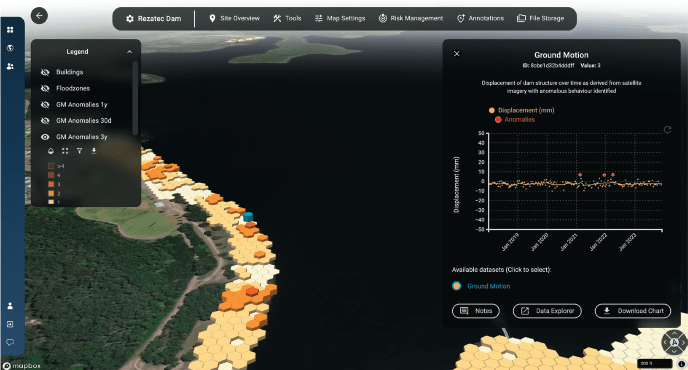
Understanding Downstream Exposure from Space
High-resolution geospatial analysis identifies new buildings and expanding infrastructure within downstream flood extents, helping teams recognize where consequence exposure is increasing.
Satellite-derived mapping highlights changes in settlement patterns and infrastructure distribution across downstream areas, supporting more informed screening and portfolio-level comparison.
Together, these insights provide consistent, repeatable visibility into downstream exposure growth—enabling a more proactive and structured approach to consequence management.
Explore Our Insights on Geospatial Analytics
Frequently Asked Questions
What is Rezatec Downstream Hazard monitoring?
Rezatec Downstream Hazard monitoring gives dam owners, operators and regulators clear visibility of what lies within their inundation zones. Using geospatial analytics with automated building and address identification, it detects downstream development, flags hazard creep between inspection cycles, and helps prioritise dams for review — strengthening Emergency Action Planning and hazard-classification defensibility across a portfolio.
What is downstream hazard monitoring?
Downstream hazard monitoring assesses what lies within a dam’s inundation zone — the homes, roads, utilities and communities that could be affected if the dam failed. Rezatec identifies this downstream exposure using geospatial analytics, so dam safety teams can understand and prioritise consequence risk across their portfolio.
How does Rezatec identify downstream exposure?
Rezatec uses advanced geospatial analytics to automatically identify buildings and associated address data within inundation zones, detect urban growth inside flood extents, and screen for exposure changes. The analysis is consistent and repeatable across entire dam portfolios.
How does satellite data reveal downstream change over time?
Rezatec analyses development patterns and land use change within flood-prone corridors using satellite-derived intelligence. High-resolution analysis identifies new buildings and expanding infrastructure inside flood extents, giving a repeatable picture of how downstream exposure evolves between formal review cycles.
Who uses Rezatec Downstream Hazard monitoring?
Rezatec Downstream Hazard monitoring is trusted by dam operators and state regulators, including the City of Spokane, SJWD and Hunter Water, to bring clarity to downstream exposure and support risk-informed dam safety decisions.